
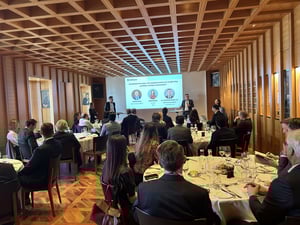
Hubfinance’s inaugural private lunch in Zurich brought together a select group of family offices, CIOs and senior investment professionals for a closed-door exchange.
The objective was not to produce a market view, but to create space for a more candid discussion: one that goes beyond positioning and into how investment decisions are actually being framed today.
What emerged was not a consensus, but a shared sense that the foundations of portfolio construction are evolving.
From stability to structural change
For years, investors operated within a relatively stable environment. Liquidity was abundant, inflation subdued, and central banks acted as a reliable anchor. Within that framework, the roles of each asset class were well understood. Bonds provided stability, equities compounded returns, and credit offered additional yield.
That equilibrium is now shifting.
Inflation is no longer treated as a temporary disruption. The idea of “higher for longer” is forcing a reassessment of fixed income, which may still generate nominal yield but no longer consistently delivers real protection. At the same time, liquidity is becoming more selective. Private credit, for instance, remains structurally attractive, but early signs of stress among weaker managers are starting to appear.
In that context, risk is not disappearing: it is moving, across instruments, managers and structures.
Long-term discipline in a more uncertain environment
Despite this more complex backdrop, one point was repeatedly brought back into the discussion: the importance of maintaining a long-term perspective.
Markets have absorbed far greater shocks than those currently in play, from geopolitical crises to systemic disruptions, and have consistently rewarded disciplined investors over time. As one participant put it, history may not repeat itself, but it often rhymes.
The challenge lies in remaining aligned with that discipline when short-term uncertainty intensifies. The instinct to reduce exposure during periods of stress remains one of the most persistent and costly behaviors in investing.
Rethinking diversification in practice
Diversification remains central to portfolio construction. Still often described as one of the few structural advantages available to investors, it continues to play a key role but its implementation is becoming more demanding.
In private markets, the shift is clear. Access is no longer the differentiating factor. Manager selection is. In a tighter liquidity environment, the gap between top-tier and weaker managers is expected to widen significantly.
Within liquid markets, similar dynamics are emerging. As highlighted during the discussion by Matthias Ramser (CIO, Reichmuth & Co Privatbankiers), many portfolios that appear diversified still carry meaningful concentration risks. This is particularly visible in the weight of US mega-cap equities within global indices, as well as in exposure to highly indebted sovereign issuers.
As a result, investors are gradually adjusting their approach. Portfolios are becoming more regionally balanced, with reduced reliance on dominant markets. There is also a visible shift in equity style, with value regaining relevance in a higher-rate environment.
Emerging markets, long underweighted, are being revisited for their relative valuation and growth potential. Commodities are also being approached more broadly, moving beyond gold to include energy, industrial metals and agriculture as part of a more balanced inflation strategy.
Currency moves back to the center
Currency is no longer treated as a secondary layer of portfolio construction.
This shift was notably highlighted by Serena Wong (founder of Women in Family Offices), who emphasized how currency exposure is increasingly approached as a structural dimension of portfolio design rather than a tactical overlay. In international family office structures, misalignment between investment and spending currencies can gradually erode real returns, especially in more volatile FX environments.
This perspective was echoed across the discussion, with José Miguel Raffo underlining that aligning investment and spending currencies should not be seen as a short-term adjustment, but as a core discipline embedded in portfolio construction.
At the same time, the US dollar continues to play a central and complex role. It acts as a global liquidity anchor while also introducing asymmetries and hidden concentration risks.
From a European perspective, the Swiss franc remains a key reference point. Swiss-based investors tend to minimize foreign exchange exposure, while euro-based investors increasingly view CHF as a defensive allocation within their portfolios.
Technology as a driver of better decisions
Technology was not discussed as a standalone investment theme, but as a transformation of the decision-making process.
Thomas Wille noted that artificial intelligence and data tools have the potential to significantly enhance how investors understand and serve their clients. From more granular risk analysis to portfolio customization and faster access to information, technology is reshaping how decisions are made.
As noted by Thomas Wille, artificial intelligence and data-driven tools are already reshaping how investors analyse portfolios and interact with clients. From more granular risk analysis to portfolio customization and faster access to information, technology is enhancing decision-making frameworks.
At the same time, this evolution introduces new dependencies. Model risk, data quality and algorithmic transparency are becoming increasingly relevant considerations. Technology does not replace human judgment: it amplifies it, while requiring stronger governance frameworks.
A more demanding investment environment
What stood out in Zurich was not a specific market call, but a level of nuance.
Portfolio construction is becoming more demanding. Less driven by broad allocation trends, and more by selectivity, discipline and a deeper understanding of underlying risks. Traditional anchors are less reliable, dispersion is increasing, and macro variables, particularly inflation and currency, are playing a more central role again.
In that environment, opportunities are less immediately visible. What remains, however, is the importance of disciplined construction. Diversification, when thoughtfully implemented rather than assumed, continues to play a central role.
This first Zurich edition marks the beginning of an ongoing dialogue in Switzerland: one that brings together investors not to align on views, but to refine how those views are formed.
The conversation will continue in Geneva on June 18, where a broader group of investors and decision-makers will gather to further explore the evolving frameworks shaping portfolio construction and long-term capital allocation alongside selected partners including 1875 Finance, Exane AM, 21Shares, UMA Wealth, Millésime Private, Hashdex, Arab Bank Switzerland and Capital Y, among others.