

In a landmark move for European finance, Luxembourg’s Intergenerational Sovereign Wealth Fund (FSIL) has allocated 1% of its approximately $730 million portfolio, equaling roughly $7.3 million, to Bitcoin exchange-traded products (ETP).This makes Luxembourg the first Eurozone nation to invest sovereign capital in Bitcoin. 21Shares shares its in-depth analysis of what this decision means for global markets and the evolving role of Bitcoin as a sovereign-grade asset.
Announced mid-October, this makes Luxembourg the first Eurozone nation to invest sovereign capital in Bitcoin at the state level. The decision follows a July 2025 policy revision allowing up to 15% of FSIL’s assets in alternative investments, including 1% in cryptoassets. Finance Minister Gilles Roth highlighted the allocation as a strategic hedge against inflation and currency debasement, underscoring Bitcoin’s growing appeal as a diversified asset in uncertain times.
This modest yet symbolic 1% stake exemplifies how Bitcoin is reshaping global finance. Once dismissed as speculative, it’s now emerging as a macro asset embraced by institutions worldwide. Backed by spot ETFs and increasing regulatory clarity in 2025, Bitcoin surged past the $100k mark, up nearly 15% year-to-date. With corporations, governments, and now sovereign funds like FSIL piling in, the question arises: Can Bitcoin truly rival gold in traditional portfolios?
Bitcoin’s Fundamentals
To understand the role Bitcoin could play, it’s worth going back and unpacking its fundamentals. Created in 2009 by Satoshi Nakamoto amid the global financial crisis, Bitcoin was designed as a peer-to-peer monetary system immune to central bank interference. Its core feature is scarcity: the supply is capped at 21 million coins, with over 95% already mined. New issuance follows a predictable schedule, halving every four years to reduce the flow of new Bitcoin. Today, Bitcoin’s inflation rate is lower than gold’s, contrasting sharply with fiat currencies prone to political expansion. For investors, this positions Bitcoin as a reliable hedge against debasement.
But Bitcoin transcends gold in utility, it’s easier to store, transfer, divide, and verify, with unmatched transparency. Globally accessible, infinitely portable, and counterfeit-resistant, it reimagines gold for the digital age as a programmable store of value.

Figure 1 – Bitcoin’s Circulating Supply vs. Block Reward (21Shares, Glassnode. Data as of October 20, 2025)
Institutions Are Catching On and Amplifying the Supply Squeeze
The core fundamentals of Bitcoin have been in place since its creation. What has changed is who is catching on. On the corporate side, the use of Bitcoin as a treasury reserve has accelerated. MicroStrategy, the largest public holder, now owns more than 640,000 BTC, more than 3% of Bitcoinʼs total supply. They are not alone: corporates collectively added more than 450,000 BTC to balance sheets this year, setting a new benchmark for institutional adoption.
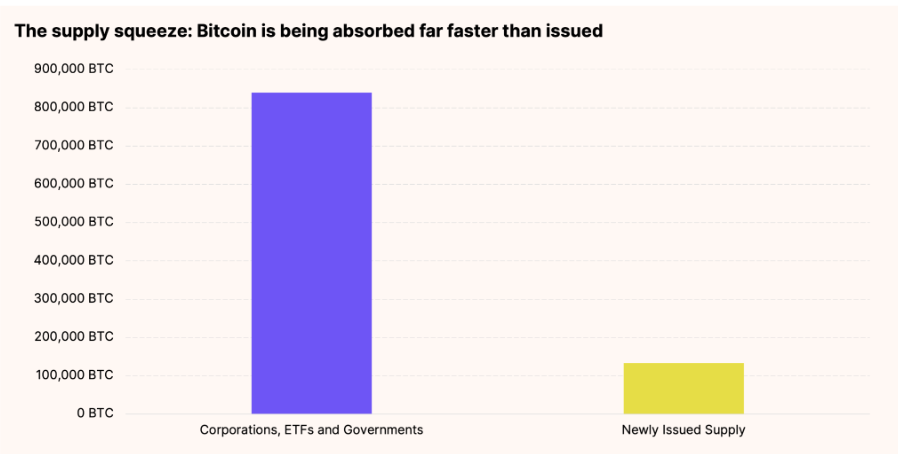 Figure 2 – Bitcoin’s Newly Issued Supply in 2025 vs. Bitcoin Absorbed by ETFs, Corporations and Governments. (21Shares, BitcoinTreasuries, Glassnode.).
Nation-states are also following suit. In March, the U.S. launched its Strategic Bitcoin Reserve, instantly becoming the largest holder with more than 200,000 BTC. States such as New Hampshire and Arizona have passed Bitcoin reserve laws, while Pakistan, Bhutan, and El Salvador continue to expand national strategies. Luxembourgʼs FSIL joins this roster, signaling Bitcoinʼs maturation as a sovereign-grade asset. Even a 1% allocation from a $730 million fund adds meaningful demand, particularly when scaled across other global sovereign wealth funds managing trillions. Together, these developments confirm Bitcoinʼs growing status as a sovereign-grade asset.
This institutional and sovereign demand is colliding with Bitcoinʼs engineered scarcity. So far this year, only around 112,000 new BTC have been mined, yet corporates, ETFs, and nations have collectively acquired over 6x the newly issued supply. The imbalance is stark: buyers are absorbing new supply many times over, and these are not speculative flows. Corporate treasuries and sovereign reserves represent structural, long-term holdings, while ETF buyers tend to have multi-year investment horizons.
At the same time, nearly half of all Bitcoin has not moved in over three years and the share of coins held on exchanges has fallen to its lowest level since 2018, with more supply moving into cold storage, institutional treasuries, and sovereign reserves. The stage is set for a structural supply squeeze: as demand ramps, circulating supply is shrinking.
Why Now? Macro Tailwinds Fuel the Shift
Against this backdrop, the real driver becomes clear: it’s not just adoption for the sake of it, but a wider economic shift that is pushing investors, corporates, and governments toward hard assets like gold and Bitcoin. The broader macroeconomic climate has defined much of 2025. Tariff escalations in the U.S. reignited fears of weaker growth and stickier inflation, with the average tariff rate now at 18.6%, the highest since the 1930s. Long-term government debt markets have wobbled, breaking away from gold’s surge and signalling deeper concerns about sovereign balance sheets. Currency weaponisation and rising fiscal fragility are forcing investors to rethink where they can safely store value.
Gold has been a clear beneficiary, up more than 60% year-to-date to hit a $30 trillion valuation, with significant net flows of over $50 billion, into ETFs and repositioning from major central banks. But Bitcoin’s performance has been just as telling. During the depths of the trade war in Q2 this year, held above pre-election levels, unlike major equity indices, underscoring its resilience in turbulent conditions, since then peeling away to be up nearly 15% on the year.
Part of this reflects Bitcoin’s role as a hedge against monetary debasement. With inflation not fully out of sight and rate cuts on the horizon, the risk of looser monetary policy fuelling currency dilution is back on the table. Bitcoin’s tight correlation with global money supply shows that investors increasingly use it to position against that risk. Its appeal lies in being both scarce and liquid, an alternative that cannot be debased at political discretion. Add in the fact that retail adoption in countries grappling with inflation such as Turkey and Argentina, already tops 15–20%, and it’s clear: Bitcoin’s hedge function is resonating across both developed and emerging markets.
The upshot for Bitcoin is an asset with a dual profile. Bitcoin still behaves like a growth play during risk-on phases, but increasingly shows defensive qualities in systemic stress. Volatility is compressing, price floors are rising, and its investor base is broadening from crypto-natives to institutions, corporates, and now sovereigns like Luxembourg’s FSIL. In short, Bitcoin is evolving into the very thing it was designed to be: a global macro asset, scarce by design, and positioned as one of the most asymmetric opportunities in today’s investment landscape.
Correlation and Portfolio Analysis: Bitcoin’s Jekyll & Hyde Nature
For allocators considering following Luxembourg’s lead or evaluating whether Bitcoin offers tangible benefits for traditional portfolios, the proof is in the data. Let’s examine through correlation and portfolio analysis why a strategic allocation, like FSIL’s 1% stake, can enhance diversification and performance without undue risk.
For mainstream portfolios, the real question isn’t just yet, whether Bitcoin replaces gold, but whether it
complements it. Correlation analysis offers a clear lens into that role. From the last three years, Bitcoin, Ethereum, and the broader crypto market all showed consistently low correlations with traditional asset classes, averaging just 30–35%. By contrast, equities, bonds, and real estate often cluster above 50%, limiting diversification.

Figure 3– Correlation of Returns Across Asset Classes (21Shares, Bloomberg, Yahoo Finance).
Bitcoin’s average correlation with U.S. equities is just 22%, and only 11% with gold. Structurally, it shares gold’s store-of-value traits yet its behavior, as previously mentioned shifts with the macro regime. This adaptive profile makes Bitcoin unique: neither fully risk-on nor risk-off, but a dynamic blend of both.
For investors, this duality is not a flaw but a feature. It means Bitcoin brings genuinely independent return streams into portfolios, diversifying risk rather than amplifying it. As crypto matures, correlations within the asset class itself are also beginning to decouple, Ethereum and the broader market are showing differentiated narratives that could evolve into distinct cycles.
To assess Bitcoin’s role in a real-world context, we tested its impact within a diversified multi-asset portfolio. We used a model allocation that better reflects the complexity of modern investor strategies, combining equities (50%), fixed income & credit (30%), and alternatives (20%), incorporating gold (5%), real estate (5%), and private equity (10%).
From this base, we introduced a 5% Bitcoin allocation, funded by trimming US equities, gold and real estate. This reflects Bitcoin’s blended profile as an alternative growth asset:
● Stronger Risk-Adjusted Returns: Cumulative returns rose to 65.34%, over 20% higher than the
benchmark portfolio. Sharpe ratios improved materially, highlighting that Bitcoin boosted portfolio
efficiency rather than duplicating risk.
● Manageable Volatility: Despite Bitcoin’s reputation for sharp swings, annualized portfolio volatility
remained between 10.74% and 11.76%, only slightly above the benchmark’s 10.34%. This shows Bitcoin’s volatility doesn’t scale linearly at the portfolio level.
● Well-Contained Downside: Maximum drawdowns stayed clustered around –15%, nearly identical to the benchmark. Relative drawdowns peaked at just –0.52%, underscoring that even with higher exposure, Bitcoin did not materially worsen downside risk.
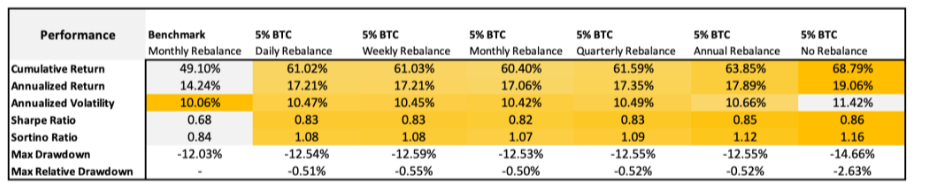 Figure 4 – Simple Growth Portfolio with a 5% BTC Allocation Across Different Rebalancing Strategies (21Shares, Bloomberg, Yahoo Finance.)
Bitcoin is proving itself as a portfolio-grade asset. A thoughtfully sized allocation can materially improve returns and efficiency without meaningfully increasing risk. Its Jekyll & Hyde nature, growth in risk-on regimes, defense in times of stress, makes it a powerful complement to traditional safe havens like gold, rather than a replacement, at least for now.
Altogether, from its beginnings as a niche experiment to its emergence as a macro asset, Bitcoin has matured into something fundamentally different. Correlation and portfolio analysis confirm that Bitcoin adds diversification benefits at scale, strengthening performance while maintaining resilience. Gold will remain a cornerstone of safe-haven allocations, but Bitcoin’s evolution means it now deserves a seat at the same table. For mainstream investors, including sovereign funds like Luxembourg’s FSIL, the question is no longer if Bitcoin belongs in portfolios, but how exposure should be scaled in the years ahead.