

In a tense international environment, geopolitical risks are back at the forefront of investors' minds. But how can we measure their real impact on the markets? And above all, how can we protect ourselves effectively?
François-Xavier Chauchat, member of the Investment Committee at Dorval AM, shares his strategic analysis with Sophie Chauvellier and Gustavo Horenstein, addressing the mechanisms of volatility and the hedging levers to be favored in this uncertain context.
Geopolitical tensions, such as those we are currently experiencing, almost systematically lead to an increase in volatility on financial markets. In the case of the conflict between Israel and Iran, this increase has remained relatively contained, offering a window of opportunity to implement hedging strategies at reasonable cost.
Geopolitical risks" are frequently cited by savers and investors as determining factors in their reading of the markets. But how can we define precisely what this notion covers? And above all, how can we rank the importance of the events concerned?
In a landmark article published in 2022, Dario Caldera and Matteo Iacoviello propose a rigorous definition of geopolitical risk: "the threat, realization or escalation of undesirable events - wars, terrorism, diplomatic tensions - likely to impede the peaceful course of international relations." Using this definition, the authors constructed a geopolitical risk index based on the number of mentions of such tensions in a selection of major Anglo-Saxon newspapers since 1985 (see graph 1).
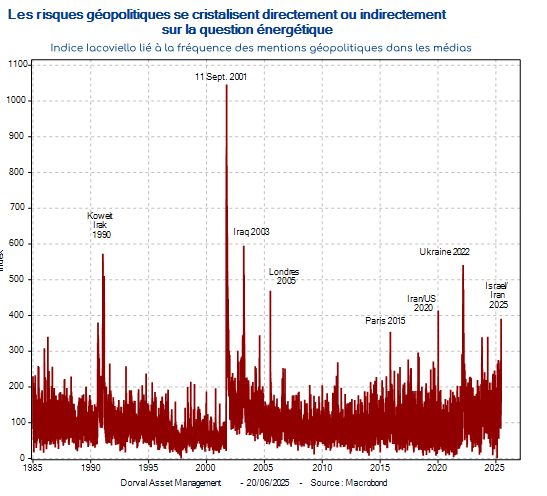
As in the 1970s - the 1973 Yom Kippur War, the 1979 Iranian Revolution - energy issues dominate, almost always in connection with the Middle East. The invasion of Ukraine was a geographical exception, but not an energy one: it profoundly disrupted Europe's oil and, above all, Russian gas supplies. As for the attacks in New York, London and Paris, their economic impact had less to do with the emotion aroused than with the potential reprisals against oil-producing states.
One way of measuring the effect of these events on the markets is the VIX index - sometimes nicknamed the "fear index" - which reflects the implied volatility of the S&P 500. When a geopolitical shock pushes the index above 300 (three times its average level), the VIX generally rises above its historical median (see graph 2).

The current episode of tension between Israel and Iran stands out for the relative calm of the markets (as of June 19, 2025): volatility has not exceeded 22, a level close to its historical average. Investors remain cautious, but are not rushing to sell risky assets, as the conflict could remain contained and/or short-lived. It could even pave the way for positive prospects: a weakening of the Iranian regime would reduce regional risks (terrorism, maritime disruptions) and could, in time, encourage the lifting of international sanctions. Iran, it should be remembered, accounts for around 4% of the world's oil production and holds the third-largest proven reserves.
From the point of view of portfolio protection, this context of limited volatility offers opportunities. All too often, major geopolitical events trigger a rapid rise in volatility, which considerably increases the cost of hedging. This is not the case today, which has enabled us to implement a low-cost hedging strategy that we believe to be timely following the sharp upturn in the markets since the beginning of April. For all our flexible and diversified funds, we have initiated a combination of put options on the Euro Stoxx 50, with a view to partially protecting our portfolios. We chose the Euro Stoxx 50 because its sensitivity to oil prices is generally higher than that of other indices such as the S&P 500. By opting for an option strategy rather than lowering our equity exposure, we are able to remain well invested in the event of a lull in the conflict.
Against this backdrop, our Dorval Convictions fund (FR0010565457) is an excellent way to gain exposure to European equities, without taking on all the risk. In fact, this fund has 3 key assets:
- 1. Its ability to adapt to market conditions by adjusting its exposure to European equities reactively, from 0% to 100%.
- 2. A strategic vision of investment opportunities based on the economic cycle. The highly experienced management team analyzes the economic and market environment to identify promising themes.
- 3. A balance between risk control and opportunity.
With a YTD performance of 6.7% and a net equity exposure rate of 59% as of June 20, 2025, Dorval Convictions is an excellent vehicle for helping your clients invest in European equities.
The information presented does not constitute a contractual commitment, nor does it constitute investment advice.
Past performance is no guarantee of future results.
Equity investments are subject to significant price fluctuations. Fixed-income investments are particularly sensitive to changes in interest rates, and the fund could lose value if interest rates rise. The fund is exposed to specific risks, including discretionary management risk, risk of capital loss, equity risk, capitalization size risk, market risk, currency risk, interest rate risk, credit risk, emerging market investment risk, financial derivatives risk and sustainability risk. The capital invested is not guaranteed. You may get back less than you invested.
The characteristics, risks and fees relating to this investment are detailed in the fund's prospectus, which is available free of charge from the management company.
Before subscribing, please consult the DIC available on our website: https://www.dorval-am.com/fonds/dorval-global-conservative/#Documents-et-rapports
This article has been automatically translated using Breeze, powered by DeepL.